Crypto-Games Originals 2026
 Available in US

Table of Contents
- The catalog is the studio
- Ten titles cover five broad mechanic groups
- House-edge data makes the originals comparable
- Provably fair sits across the full catalog
- Dice and Roulette add progressive jackpots
- Dice shows how long the core has been used
- Automation is a niche extension of the game model
- Questions about Crypto-Games originals
- The originals work best when transparency matters more than breadth
Section element
A compact casino built in-house
Crypto-Games does not use a conventional third-party game lobby. Its casino product is built around 10 in-house titles: Dice, DiceV2, Roulette, Blackjack, Keno, Minesweeper, Video Poker, Plinko, Slot and Lottery. That narrow catalog makes the product easier to map because the games share one studio model, published house-edge data and the same broad provably fair approach.
Section element
- In-house games 10
- Third-party provider lobby None
- Live-dealer catalog None
- Lowest published numeric edge 1.0%
The catalog is the studio
At Crypto-Games, “originals” are not a side category next to outside providers. They are the casino itself. The operator’s game set is custom-built in-house, and independent coverage also describes it as a proprietary catalog rather than a collection of licensed third-party titles. That gives the site a very different architecture from a casino whose identity depends on dozens of software suppliers.
The practical upside is consistency. Game names, mathematical data and the provably fair model can be compared within one product family. The trade-off is equally clear: there is no huge provider carousel or live-dealer floor to explore. Readers who want broader context can compare this structure with the complete Crypto-Games games overview.
Probability-first games
Dice, DiceV2, Keno and Minesweeper put simple probability structures near the center of the catalog. Their published numeric house edges are all 1.0%.
Familiar casino forms
Blackjack, Roulette and Video Poker bring recognizable card and table-style formats into the same in-house environment rather than importing external studio versions.
Visual mechanics
Plinko and Slot add more visual, arcade-like or reel-driven play, while Lottery completes the catalog with a draw-style format whose exact edge figure is inconsistent across sources.
Ten titles cover five broad mechanic groups
The 10 names can be organized editorially by how they play. The categories below are a navigation aid rather than official product labels; they do not add features beyond the game names listed here. The goal is to show what kind of variety exists inside a deliberately small library.
| Game | Mechanic group | Published house edge |
|---|---|---|
| Dice | Dice / probability | 1.0% |
| DiceV2 | Dice / probability | 1.0% |
| Roulette | Table-style | 2.7% |
| Blackjack | Card / table-style | 1.25% |
| Keno | Number game | 1.0% |
| Minesweeper | Arcade-like / probability | 1.0% |
| Video Poker | Card game | 2.09% |
| Plinko | Arcade-like | 1.72% |
| Slot | Reel game | 1.97% |
| Lottery | Number / draw game | Very low / near-zero; sources differ |
Four games sit at the 1.0% published edge level: Dice, DiceV2, Keno and Minesweeper. Blackjack is listed at 1.25%, Plinko at 1.72%, Slot at 1.97%, Video Poker at 2.09% and Roulette at 2.7%. Published Lottery figures differ, so it remains descriptive rather than numeric.
House-edge data makes the originals comparable
A proprietary catalog becomes more useful when the games can be compared on the same mathematical dimension. House edge is the long-run percentage advantage built into a game. It does not say what will happen in the next spin, deal or roll; it describes expected cost across a large volume of wagering.
Consider two reader scenarios. At a 1.0% edge, $1,000 of total wagering corresponds to a theoretical $10 expected loss. At a 2.7% edge, the same turnover corresponds to $27. The important number is therefore not only the percentage but also how much is wagered in total. Repeated small bets can create the same turnover as a smaller number of large bets.
- 1.0% tier
- Dice, DiceV2, Keno and Minesweeper
- 1.25%
- Blackjack
- 1.72%
- Plinko
- 1.97%
- Slot
- 2.09%
- Video Poker
- 2.7%
- Roulette
Provably fair sits across the full catalog
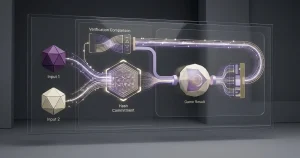
All 10 games use a provably fair model based on hashes and seeds. That gives the in-house model a second layer beyond published edge data: the house edge describes the mathematics, while provably fair verification addresses whether a specific result is consistent with the cryptographic inputs used to generate it.
Those ideas should not be merged. A result can be cryptographically checkable and still come from a game with a house advantage. Likewise, a low-edge game can still be volatile. The dedicated Crypto-Games provably fair guide explains the hash-and-seed workflow without assuming verifier controls that are not shown.
- Use house edge to understand the long-run mathematical cost.
- Use provably fair verification to inspect result integrity.
- Keep variance separate from both concepts; neither predicts a short session.
- Compare game mechanics as well as headline percentages before deciding what risk you understand.
Dice and Roulette add progressive jackpots
Crypto-Games offers progressive jackpots on Dice and Roulette. Within a 10-game catalog, that matters because it gives two core titles a second prize layer without changing the overall studio model. The presence of a jackpot should not be read as a change to the base game’s mathematical risk; it is an additional feature attached to the title.
From an editorial perspective, the useful distinction is between a game’s standard house-edge figure and an extra progressive prize mechanism. A larger possible prize can change the distribution of outcomes, but it does not make repeated wagering costless or predictable.
Dice shows how long the core has been used
Dice is the clearest longevity signal in the in-house catalog. Industry coverage reported that the game passed roughly 9.2 billion bets. That milestone does not say anything about an individual player’s chances, but it does show how central a simple probability game has been to Crypto-Games over a long operating history.
The casino launched in 2014 and began with a much smaller product than it has now. The current 10-game set can therefore be read as an expanded version of the same core idea: proprietary games, crypto-native payments and transparent mathematical mechanics rather than a rotating feed of external releases.
Automation is a niche extension of the game model
Player reports describe an API for bots or automated betting. That feature fits the technical character of the catalog, especially for users who want programmatic interaction with repeated betting mechanics. The public details are not specific enough to describe exact API controls here.
Automation does not change the house edge. If a strategy executes more bets faster, total turnover can rise quickly, which increases exposure to the same underlying mathematical advantage. That makes bet volume and stop conditions more important, not less.
For the broader operator context beyond game design, return to the full Crypto-Games review.
Questions about Crypto-Games originals
What are Crypto-Games originals?
Crypto-Games originals are the casino’s own in-house games rather than titles licensed from third-party studios. The catalog contains 10 games.
Which games are in the Crypto-Games in-house catalog?
The catalog consists of Dice, DiceV2, Roulette, Blackjack, Keno, Minesweeper, Video Poker, Plinko, Slot and Lottery.
Does Crypto-Games use third-party game providers?
No. The casino product is built around its own games, without a third-party provider lobby or live-dealer catalog.
Which Crypto-Games originals have the lowest published house edge?
Dice, DiceV2, Minesweeper and Keno are each published at a 1.0% house edge. Blackjack is listed at 1.25%, followed by Plinko, Slot, Video Poker and Roulette at higher published figures.
What is the Lottery house edge?
Published Lottery figures differ, so it is better described as very low or near-zero rather than assigned one fixed number.
Are there progressive jackpots in the in-house catalog?
Crypto-Games offers progressive jackpots on Dice and Roulette.
Does Crypto-Games support automated betting?
Player reports describe an API for bots or bet automation. Treat it as a niche advanced-use feature rather than a requirement for normal play.
The originals work best when transparency matters more than breadth
Crypto-Games builds its casino around 10 proprietary titles rather than a large provider marketplace. The advantage is inspectability: the catalog is small, named, mathematically comparable and tied to one provably fair framework. The cost is limited breadth. Readers who prefer a focused set of in-house mechanics can understand the product quickly; readers who want a large live or third-party lobby will find the catalog intentionally narrow.
Crypto-Games Originals 2026 — More on this topic at Crypto-Games Review.
See also Crypto-Games Withdrawal 2026.