
Single-brand crypto casino review
Crypto-Games Review 2026
 Available in US
Crypto-Games is an unusually compact crypto-native casino: it has operated since 2014, runs 10 in-house games instead of a third-party catalog, publishes game-level house edges, and uses a provably fair model built around hashes and seeds. That narrow product design is the central fact to understand before looking at payments, bonuses or account checks.

Table of Contents
- Crypto-Games is a 10-game in-house crypto casino
- A compact in-house casino model changes the comparison
- Published house edges make repeated betting easier to model
- Model the house-edge exposure of a betting session
- Crypto payments are fast-moving, so the payment dialog matters
- Minimal onboarding does not mean permanent anonymity
- Bonus size matters less than the turnover attached to it
- Trust signals need both the long history and the complaint pattern
- The product fit depends on whether transparency outweighs catalog breadth
- Crypto-Games questions on games, payouts and KYC
- The narrow catalog is the main decision point
Crypto-Games is a 10-game in-house crypto casino
The casino is better understood as a small in-house game system than as a conventional lobby with hundreds of suppliers. Its strongest differentiators sit in the mechanics: a fixed set of original games, published house-edge figures, provably fair verification, a PlayMoney faucet and a niche API/bot feature.
- Established2014
- Game catalog10 in-house titles
- Fairness modelProvably fair
- Software modelNo third-party studios
- Free testingPlayMoney faucet
- Mobile accessBrowser-based
- 10in-house games
- 1.0%published edge on Dice, DiceV2, Minesweeper and Keno
- 9.2B+Dice bets at a long-running milestone
A compact in-house casino model changes the comparison
Crypto-Games lists Dice, DiceV2, Roulette, Blackjack, Keno, Minesweeper, Video Poker, Plinko, Slot and Lottery. All 10 are in-house titles. There is no third-party studio catalog, no live-dealer section and no sportsbook. That makes the product structurally different from aggregator casinos where the main question is usually how many providers or tables are available.
For a reader, the comparison therefore shifts from catalog breadth to mechanics. You can examine the published edge on individual games, understand how provably fair verification works, and decide whether a compact set of titles is enough variety. The dedicated Crypto-Games games guide goes deeper into the full catalog, while the originals section separates the house-built model from typical supplier-driven casinos.
The catalog is intentionally small
Ten named titles make it practical to understand the full product without scrolling through hundreds of skins and near-duplicates. The trade-off is obvious: readers who mainly want live tables or a large studio selection will not find that breadth here.
Game math is unusually visible
The numeric game figures range from 1.0% on several games to 2.7% on Roulette. Lower edge does not mean low volatility, but it gives a concrete basis for long-run cost comparisons.
PlayMoney separates testing from funding
The current faucet dispenses an internal PlayMoney balance for free testing. It is not a real-crypto faucet. That distinction matters because practice play can help you inspect mechanics without treating faucet credits as withdrawable cryptocurrency.
Automation is a niche extra
An API supports bots and automated betting. That is a specialist feature rather than a reason to increase stake size: automation changes execution speed, not the underlying edge or variance.
Published house edges make repeated betting easier to model
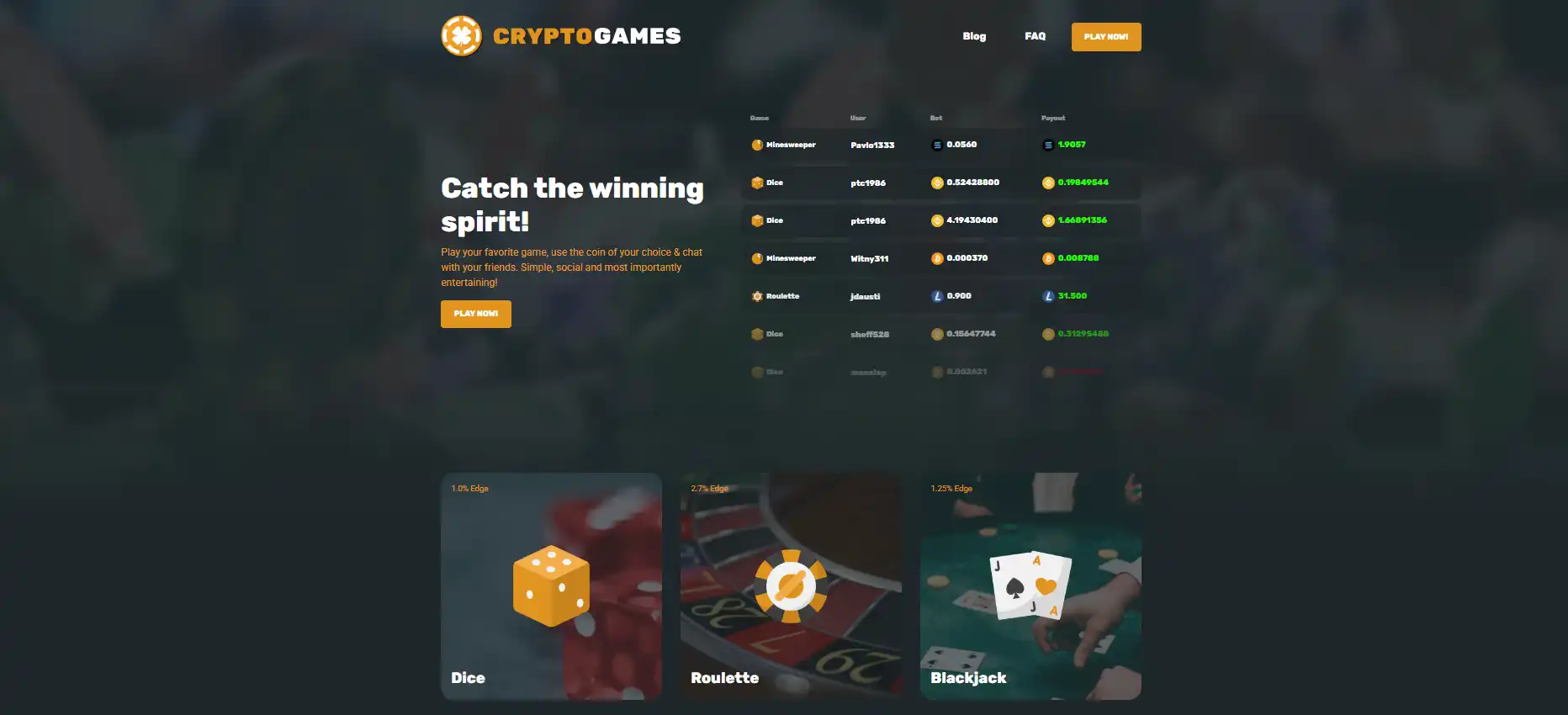
Crypto-Games publishes a house edge for each named game. The consistent numeric values show four games at 1.0%, Blackjack at 1.25%, Plinko at 1.72%, Slot at 1.97%, Video Poker at 2.09% and Roulette at 2.7%. Published figures for Lottery differ; check the current game display instead of relying on one fixed percentage.
House edge is a long-run average, not a session forecast. At a 1% edge, a total of 100 scenario units wagered corresponds to one unit of theoretical expected loss over a very large number of comparable bets. A real session can finish far above or below that expectation because variance dominates short samples. Re-betting winnings also increases total turnover, so the relevant base is cumulative amount wagered rather than only the first deposit.
| Game | Published house edge | Long-run interpretation |
|---|---|---|
| Dice | 1.0% | 1 unit of theoretical edge cost per 100 units wagered |
| DiceV2 | 1.0% | Same long-run edge rate as Dice |
| Minesweeper | 1.0% | Low published percentage; session variance still matters |
| Keno | 1.0% | Low published percentage; not a return guarantee |
| Blackjack | 1.25% | 1.25 units per 100 wagered in the long-run model |
| Plinko | 1.72% | Higher modeled edge cost as turnover rises |
| Slot | 1.97% | Roughly 1.97 units per 100 wagered in the model |
| Video Poker | 2.09% | Edge compounds with repeated betting volume |
| Roulette | 2.7% | Highest consistent numeric edge in this table |
All of the casino’s games use a provably fair approach based on hashes and seeds. In practical terms, the cryptographic process can help a player check that a result corresponds to committed inputs rather than accepting an opaque outcome. It does not turn a game into a positive-expectation bet, remove variance or resolve account-service questions. For a step-by-step explanation, see the provably fair verification guide.
- Start with the published edge for the specific game rather than treating the whole casino as one RTP number.
- Track total turnover, because repeated bets increase the amount exposed to the mathematical edge.
- Use provably fair checks to inspect result integrity, while keeping mathematical expectation and account handling as separate questions.
Game math explorer
Model the house-edge exposure of a betting session
Choose one of Crypto-Games’ in-house games, set a scenario stake and number of bets, and compare the total amount wagered with the game’s published house edge. The result is a theoretical long-run average, not a prediction of what any session will return.
The $ sign is only a neutral scenario value unit. It does not imply a required fiat balance or deposit currency.
Medium modeled exposure. Repeated betting magnifies the mathematical edge even when the percentage is low, while short-session variance can be much larger than this average.
How this works
Total amount wagered equals stake per bet multiplied by number of bets. Theoretical expected loss equals total amount wagered multiplied by the selected game’s house edge divided by 100.
House edge is a long-run mathematical average. Crypto-Games uses a provably fair model based on hashes and seeds; that can help verify result integrity, but it does not remove variance or the game’s mathematical edge.
18+ only; the minimum legal age can be higher depending on where you live. Gambling Therapy (gamblingtherapy.org) offers international support. Check your local helpline and gambling laws in your own country.
Crypto payments are fast-moving, so the payment dialog matters
Crypto-Games supports a broad set of assets including BTC, ETH, USDT, USDC, XRP, BNB, SOL, DOGE, LTC, BCH, SHIB, PEPE, ETC and POL/MATIC, alongside PlayMoney for internal testing. The supported mix has changed over time, so the live payment dialog is the practical place to confirm the currently available asset and network before sending funds.
Withdrawals are generally fast or near-instant, while network congestion and account checks can extend the wait. The platform does not add a withdrawal fee; the user still bears the relevant network fee. Published minimum-deposit figures differ, and crypto thresholds can depend on the asset or network. For asset-by-asset transaction checks, use the payments guide.
What is structurally simple
- The product is crypto-native rather than a fiat-first casino with crypto bolted on.
- The fee model separates platform withdrawal fees from network costs.
- PlayMoney lets you inspect games without treating test credits as real crypto.
What still needs a preflight check
- Confirm the exact asset and network shown in the payment dialog.
- Check the current minimum for that asset instead of relying on a universal figure.
- Copy the destination address carefully because blockchain transfers are generally irreversible.
Minimal onboarding does not mean permanent anonymity
Independent reviews describe a light starting flow built around email verification, but ID checks can be requested for large withdrawals or when higher limits are involved. The possibility of later ID checks means the service is not no-KYC. The practical distinction is between low-friction access and an unconditional promise that identity documents will never be requested.
Player feedback is polarized on this point: some reviewers praise fast payouts, while recurring complaints describe account restrictions or unexpected verification during withdrawal, especially around bonus or faucet-related winnings. That pattern is useful as a preparation signal rather than a verdict. Keep account information consistent and be ready for an identity review before planning a large withdrawal. The account and KYC guide explains that workflow in more detail.
- Starting verification
- Email verification is the starting baseline.
- Possible later checks
- ID can be requested for large withdrawals or higher limits.
- PlayMoney faucet
- Internal test currency for free play; it is not withdrawable cryptocurrency.
- Mobile access
- Access is browser-based on iOS, Android and desktop; no native app is listed.
Bonus size matters less than the turnover attached to it
Independent bonus listings describe a multi-deposit welcome package advertised up to 20,000 USDT with wagering around 40×. Because promotional terms can change, the current terms are the operative offer. The important math is the wagering multiplier: a 40× requirement can turn a modest bonus balance into a large amount of required betting turnover.
For example, a purely illustrative 100-unit bonus subject to 40× wagering would imply 4,000 units of required turnover before considering game contribution rules or other terms. That arithmetic is not a statement about a specific eligible deposit at Crypto-Games; it shows why the multiplier deserves more attention than the promotional ceiling. See the Crypto-Games bonus guide for the welcome package, weekly rakeback and monthly wagering contests.
Weekly rakeback runs at roughly 10% of a turnover-related share and does not add a wagering requirement. Monthly wagering contests and a loyalty/VIP program sit alongside the rakeback.
Welcome package
Large advertised ceiling, but the current offer and eligibility terms matter more than the headline number.
Wagering
Around 40× in the cited descriptions. Higher turnover magnifies both house-edge exposure and time spent betting.
Rakeback
Weekly rakeback is a separate recurring benefit rather than part of the core game math.
Contests and loyalty
Monthly wagering competitions and VIP/loyalty features add retention mechanics around the small game catalog.
Trust signals need both the long history and the complaint pattern
The operating history is substantial for a crypto-native casino: Crypto-Games dates to 2014, and its Dice game has passed roughly 9.2 billion bets. That longevity is a meaningful operating signal, but it does not erase user-level service disputes.
Trustpilot shows an aggregate around 3.4 out of 5 from roughly 158 reviews. Positive comments repeatedly mention fast withdrawals and the custom-built provably fair games. Negative comments repeatedly mention account freezes, limits and identity checks during withdrawals. The distribution is mixed rather than uniformly positive or negative, so it is more useful to treat the review record as a list of recurring friction points to prepare for.
Signals that support the operating story
- Operating history reaches back to 2014.
- The compact in-house game identity has remained consistent over time.
- Player feedback frequently mentions quick withdrawals and provably fair mechanics.
Friction that deserves preparation
- Withdrawal-stage KYC appears in recurring player complaints.
- Account restriction disputes appear in the review history.
- Fast payout reports do not establish a guaranteed processing time.
For operator and dispute-framework details, use the license section.
The product fit depends on whether transparency outweighs catalog breadth
Crypto-Games is easiest to evaluate if you start with what it deliberately is: a long-running crypto-native casino with 10 in-house titles and published game math. That makes it a better fit for readers who want a compact set of repeatable mechanics, provably fair checks and direct crypto use than for readers who primarily want dozens of studios, live dealers or a large entertainment lobby.
The payment model also rewards careful crypto habits. The asset list is broad, but network choice, fees and current thresholds still need to be checked at transaction time. The account model is similarly simple at the beginning yet can become more demanding at withdrawal time, so low-friction onboarding is different from a permanent identity-free experience.
- Inspect the game catalog first. If the 10 in-house titles do not cover the mechanics you want, the rest of the feature set will not compensate for that narrowness.
- Compare the published edge on the games you would actually use, and model turnover rather than focusing only on a single stake.
- Review the payment flow for the asset and network you intend to use before sending funds.
- Read the account-check guidance before planning a large withdrawal, even if signup itself is light.
- Treat bonuses as optional contract terms. Calculate wagering turnover before treating any advertised maximum as economic value.
Crypto-Games questions on games, payouts and KYC
What kind of casino is Crypto-Games?
Crypto-Games is a crypto-native casino established in 2014. It uses a compact in-house model with 10 original games rather than a third-party studio catalog.
How many games does Crypto-Games have?
It lists 10 in-house titles: Dice, DiceV2, Roulette, Blackjack, Keno, Minesweeper, Video Poker, Plinko, Slot and Lottery.
Does Crypto-Games use provably fair games?
Yes. The game model uses hashes and seeds so results can be checked against cryptographic inputs. Provably fair verification addresses result integrity; it does not remove house edge or short-term variance.
How fast are Crypto-Games withdrawals?
Withdrawals are generally fast or near-instant, but network congestion and account checks can extend the wait. The fastest cases are examples rather than a guaranteed processing time.
Does Crypto-Games require KYC?
Email verification is the starting point, while ID checks can be requested for large withdrawals or higher limits. Because later ID checks can occur, the service is not no-KYC.
What is the Crypto-Games faucet?
The current faucet provides PlayMoney, an internal play balance for free testing. It is not a faucet that pays withdrawable cryptocurrency.
The narrow catalog is the main decision point
Crypto-Games stands apart through concentration rather than scale: 10 in-house provably fair games, published house-edge figures, direct crypto use and a long operating history. That makes the product unusually easy to model mathematically, but it also means there is no broad supplier or live-dealer catalog to fall back on if the house-built games do not suit you. Payments can be fast, yet network conditions and account checks still matter; onboarding can be light, yet larger withdrawals can trigger identity review. Evaluate the game model first, then payment and account mechanics, and treat bonus terms as a separate layer rather than the reason to use the casino.