
Crypto-Games Provably Fair 2026
 Available in US
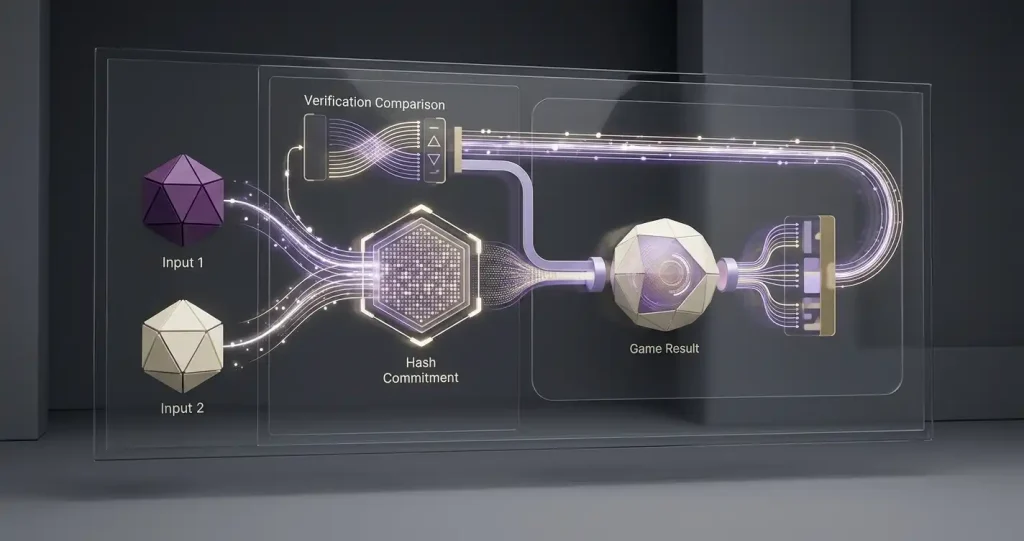
Table of Contents
- Provably fair is a verification method, not a winning system
- The hash-and-seed flow in five steps
- Four concepts make the model easier to read
- Fair verification and house edge coexist
- What the method can and cannot establish
- Crypto-Games also states RNG certification
- Use verification after the result, not as a prediction tool
- Questions about Crypto-Games provably fair games
- Provably fair adds auditability without changing gambling risk
Section element
Hash-and-seed result verification
All 10 Crypto-Games titles use a provably fair model built on hashes and seeds, so game results can be checked against cryptographic inputs. The important boundary is what that proves: the mechanism can help verify result integrity, but it does not remove the house edge, predict future outcomes, reduce variance or settle account and payment questions.
Section element
- Provably fair coverage All 10 games
- Verification basis Hashes + seeds
- Lowest published numeric edge 1.0%
- RNG statement iTech Labs certification stated by Crypto-Games
Provably fair is a verification method, not a winning system
All 10 Crypto-Games titles use a provably fair model built on hashes and seeds. In practical terms, that means the result is not presented as a black box that must simply be trusted: cryptographic data can be used to check whether the outcome is consistent with the inputs committed to the game.
That is different from asking whether a game is favorable. A game can be provably fair and still have a house edge. It can also produce a losing streak. Verification speaks to integrity of the calculation; house edge speaks to long-run expected cost; variance describes how widely short-term outcomes can move around that expectation.
Integrity
The hash-and-seed model gives a way to compare a result with cryptographic inputs rather than relying only on the animation shown on screen.
Mathematics
Published house-edge figures remain in force. Verification does not turn a negative-expectation casino game into a neutral or positive-expectation one.
Variance
A fair game can still swing sharply in the short term. Cryptographic verification does not smooth the distribution of wins and losses.
The Crypto-Games games page compares the complete catalog and published edge figures, while the originals guide focuses on how the 10 in-house titles fit together.
The hash-and-seed flow in five steps
The sequence below explains the cryptographic concept behind the hash-and-seed model rather than tying it to a particular interface. The core logic is commit first, reveal later, then recompute. The same logic is widely used in provably fair systems: commit first, reveal later, then recompute.
- Seed inputs exist before the result. A provably fair calculation begins from seed data used by the game. The exact presentation can vary, but the seeds are part of the cryptographic input set.
- A hash can act as a commitment. A hash is a one-way fingerprint of data. Publishing or exposing a commitment before the result prevents the underlying value from being silently changed later without also changing the hash.
- The game result is generated from the committed inputs. The game converts the seed material into the outcome according to its algorithm.
- The relevant data is available for checking after play. Once the result is known, the inputs needed for verification can be compared with the earlier commitment.
- The player recomputes or checks consistency. If the revealed inputs produce the same commitment and result, the cryptographic chain is internally consistent.
Four concepts make the model easier to read
- Seed
- Input data used as part of the result-generation process
- Hash
- A one-way cryptographic fingerprint used to commit to data without revealing the original value directly
- Commitment
- The pre-result reference that can later be compared with revealed inputs
- Verification
- The post-result check that the disclosed inputs and outcome remain consistent with the prior commitment
These terms describe why the method is useful. A normal visual casino interface asks you to trust that the underlying random process matches the displayed result. A provably fair design adds a cryptographic trail that can be checked independently of the animation. The technique does not by itself explain every implementation detail, and a missing UI field does not establish how that control works.
Fair verification and house edge coexist
Crypto-Games publishes house-edge figures for its in-house games, which makes the separation between fairness and expected cost especially clear. The same title can be cryptographically verifiable and still retain a mathematical advantage for the house.
| Game | Published house edge |
|---|---|
| Dice | 1.0% |
| DiceV2 | 1.0% |
| Minesweeper | 1.0% |
| Keno | 1.0% |
| Blackjack | 1.25% |
| Plinko | 1.72% |
| Slot | 1.97% |
| Video Poker | 2.09% |
| Roulette | 2.7% |
| Lottery | Very low / near-zero; exact figure differs across sources |
Dice, DiceV2, Minesweeper and Keno sit at 1.0%. Blackjack is listed at 1.25%, Plinko at 1.72%, Slot at 1.97%, Video Poker at 2.09% and Roulette at 2.7%. Published Lottery figures differ, so no single number is used here.
For a simple reader scenario, $1,000 of total wagering at a 1.0% edge corresponds to a theoretical $10 expected loss, while the same turnover at 2.7% corresponds to $27. The individual session can finish very differently because expected value is a long-run concept rather than a short-run promise.
What the method can and cannot establish
What it can help verify
- The disclosed result is consistent with the seed-based calculation.
- The revealed data matches the earlier cryptographic commitment.
- The game result can be checked separately from the visual presentation.
What it does not prove
- That the next bet will win or that a streak can be predicted.
- That the house edge disappears because the result is auditable.
- That short-term variance will be low.
- That account, bonus or payment handling will never create a separate dispute.
Crypto-Games also states RNG certification
Crypto-Games states that its random number generator is certified by iTech Labs. That is an operator claim about RNG testing and should be kept separate from the player-facing provably fair concept. RNG certification and hash-and-seed verification can both concern game randomness, but they work through different forms of evidence.
For a reader, the useful distinction is practical. Provably fair verification is something that can be understood as a result-by-result cryptographic check. An RNG certification statement is an external-testing claim about the random number system. One should not be used as shorthand for the other.
Use verification after the result, not as a prediction tool
The best mental model is an audit trail. Before the result, a cryptographic commitment prevents silent rewriting of the inputs. After the result, the relevant seed data can be checked against that commitment and outcome. The value comes from detecting inconsistency, not from revealing a future result.
- Separate the pre-result commitment from the post-result reveal.
- Check that the revealed inputs reproduce the expected hash or commitment.
- Confirm that the same inputs reproduce the displayed game result.
- Keep the house edge and total turnover in view even when verification succeeds.
For the broader operator picture, including payments and account conditions, return to the full Crypto-Games review.
Questions about Crypto-Games provably fair games
Are all Crypto-Games games provably fair?
Yes. All 10 games use a provably fair model based on hashes and seeds.
What does provably fair mean at Crypto-Games?
It means a game result can be checked against cryptographic inputs rather than accepted only on trust. Crypto-Games uses hashes and seeds as the basis of that process.
Does provably fair mean I can predict the next result?
No. Verification is retrospective: it helps check that a result is consistent with the committed inputs. It does not reveal a future winning result or remove randomness.
Does provably fair remove the house edge?
No. Crypto-Games still publishes house-edge figures for its games. Provably fair concerns result integrity, while house edge describes the game’s long-run mathematical advantage.
What house-edge figures does Crypto-Games publish?
Dice, DiceV2, Minesweeper and Keno are listed at 1.0%, Blackjack at 1.25%, Plinko at 1.72%, Slot at 1.97%, Video Poker at 2.09% and Roulette at 2.7%. Published Lottery figures differ.
Does Crypto-Games state that its RNG is certified?
Yes. Crypto-Games states that its RNG is certified by iTech Labs. That statement is separate from the player-facing provably fair hash-and-seed concept.
Provably fair adds auditability without changing gambling risk
Crypto-Games gives its 10 in-house games a cryptographic verification layer based on hashes and seeds, alongside published house-edge figures. That combination is useful because it separates two questions clearly: whether a result is internally consistent and what the game costs mathematically over time. The first can be audited; the second remains a built-in disadvantage, and neither removes volatility or the possibility of loss.
Crypto-Games Provably Fair 2026 — More on this topic at Crypto-Games Review.
See also Crypto-Games Originals 2026.