Crypto-Games License 2026
 Available in US
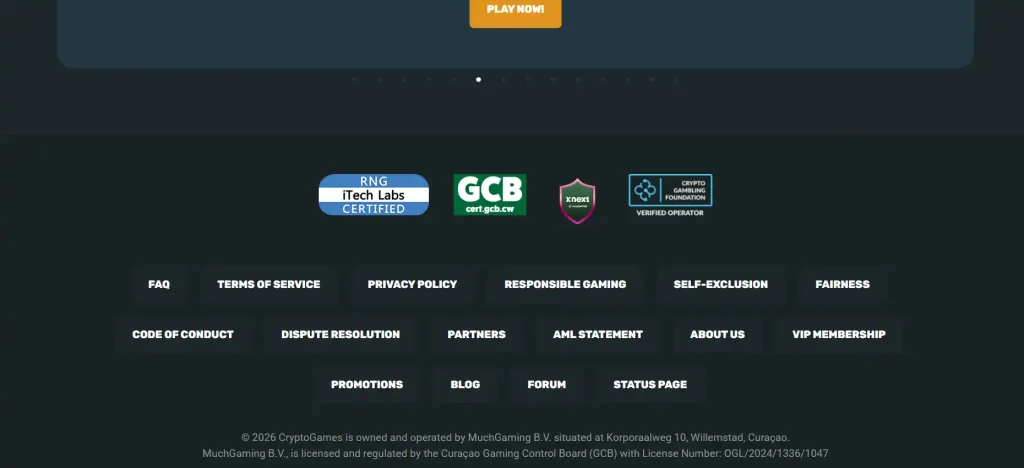
Table of Contents
- What the Crypto-Games licence statement says
- The offshore setup changes the recourse question
- A Curaçao licence does not settle local legality
- RNG certification and licensing cover different ground
- Keep a dispute file before you need one
- A practical path through an offshore dispute
- Player complaints show where friction can emerge
- Questions about the Crypto-Games licence
- Use Crypto-Games only with the offshore recourse limits in view
Section element
Licence and dispute context
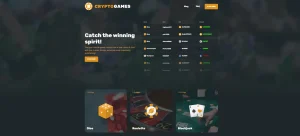
Crypto-Games presents itself as a Curaçao-licensed offshore casino operated by MuchGaming B.V. Its public footer lists Curaçao Gaming Control Board licence OGL/2024/1336/1047, while the casino also states that its RNG is certified by iTech Labs. Those credentials answer different questions: licensing concerns the operator framework, RNG certification concerns game randomness, and neither establishes local legality or a guaranteed dispute outcome where you live.
Section element
- Operator MuchGaming B.V.
- Licence shown by the casino Curaçao GCB · OGL/2024/1336/1047
- RNG certification stated by Crypto-Games iTech Labs
What the Crypto-Games licence statement says
Crypto-Games lists MuchGaming B.V. as its operator and presents a Curaçao Gaming Control Board licence in the public site footer. The number shown is OGL/2024/1336/1047. For a reader, the useful distinction is between a credential that the casino displays and assumptions that should not be built on top of it. The licence identifies the offshore framework under which the operator says it runs; it does not by itself tell you whether gambling with the site is permitted in your own jurisdiction.
The operator identity matters because account records, payment disputes and complaints ultimately attach to the business running the casino rather than to a game title or cryptocurrency address. If a problem develops, keep the operator name alongside the account email, transaction IDs and relevant correspondence. The account guide explains the verification context that can become relevant when a withdrawal triggers an identity check.
- Operator
- MuchGaming B.V., Willemstad, Curaçao
- Licensing statement
- Curaçao Gaming Control Board licence OGL/2024/1336/1047, as displayed by Crypto-Games
- RNG statement
- Crypto-Games states that iTech Labs has certified its RNG
- Local-law effect
- The offshore credential does not establish permission to gamble in your own country
The offshore setup changes the recourse question
Crypto-Games operates through a Curaçao company and an offshore licence. That structure is common enough in international crypto gambling, but the practical consequence is specific: when a player and operator disagree, the path to a remedy can be more distant than dealing with a business authorised by the player’s own national authority. Cross-border communication, evidence quality and the operator’s own support process therefore carry more weight.
What the licence can tell you
- Which operator is presented as responsible for the casino.
- Which offshore licensing framework the casino says applies.
- Which licence number the casino publicly displays.
What it does not settle
- Whether you may lawfully gamble with the site where you live.
- Whether a national consumer authority in your country can intervene.
- Whether a payment or account dispute will be decided in your favour.
That is why the useful question is not simply “does it have a licence?” but “what evidence and recourse would I have if something goes wrong?” The withdrawal guide focuses on payment timing, fees and account checks, which are the areas most likely to generate a practical record that can later be used in a complaint.
A Curaçao licence does not settle local legality
Crypto-Games is global-facing, while gambling law is local. A Curaçao licence should not be read as permission to use the casino in every country. Access restrictions and legal rules differ across jurisdictions, so a static region list should not be treated as a universal answer about where the site can be used.
Before creating or funding an account, check the gambling rules and minimum gambling age that apply where you are located. The same principle applies to tax: treatment of gambling winnings and crypto transactions depends on your country of residence, and individual circumstances may require professional advice.
RNG certification and licensing cover different ground
Crypto-Games states that its random number generator is certified by iTech Labs. That claim sits alongside the casino’s provably fair model, but it should be read narrowly. RNG certification is about the operation of game randomness; a licence concerns the operator framework. Neither one substitutes for the other, and neither removes the mathematical house edge, account rules or payment procedures.
| Signal | What it addresses | What it does not answer |
|---|---|---|
| Curaçao GCB licence statement | Operator and offshore licensing framework presented by Crypto-Games | Local legality, guaranteed recovery in a dispute, or game profitability |
| iTech Labs RNG statement | Randomness testing as described by the casino | Account treatment, payment disputes, or local consumer recourse |
| Provably fair game model | Checking result integrity through cryptographic inputs | Profit, low variance, or how an account dispute will be handled |
| Player review record | Patterns in reported customer experiences | A binding decision on any individual complaint |
The distinction matters because a strong-looking technical fairness signal can coexist with ordinary customer-service or withdrawal friction. Assess each layer on its own function instead of treating one badge or certificate as a blanket guarantee.
Keep a dispute file before you need one
Cross-border disputes are easier to explain when the underlying record is complete. The goal is not to build a legal case in advance; it is to avoid losing the transaction trail that shows what happened. Crypto payments add a useful source of evidence because transaction identifiers can connect a wallet transfer to a specific event, while account correspondence can show what the operator requested or decided.
- Keep the account email and any identity-check correspondence together.
- Save transaction IDs for deposits and withdrawals that become disputed.
- Preserve relevant game or wager records when a game result is part of the issue.
- Retain the terms or promotion wording that applied when the transaction occurred.
- Write down the sequence of support messages so the chronology stays clear.
This record also makes it easier to separate a blockchain delay from an operator decision. A transaction that has not yet reached network confirmation is a different problem from a withdrawal that is being held for an account review.
A practical path through an offshore dispute
Start with the operator’s own support or complaint route and the evidence you control. Do not assume that an offshore licence creates a specific national complaint procedure where you live.
- Identify the exact event. Separate a game-result question, account restriction, bonus condition, deposit issue or withdrawal problem. Mixing several issues into one complaint makes the timeline harder to follow.
- Preserve the record. Keep transaction IDs, account messages, game references and the terms that applied at the time.
- Use the operator’s support or complaint route. State the requested resolution plainly and attach the minimum evidence needed to show the sequence.
- Ask for the reason in writing. If an account check or restriction is involved, a written explanation is more useful than a transient chat exchange.
- Consider the offshore context. If the matter remains unresolved, remember that a Curaçao licence is not the same as having a domestic authority in your own country handling the dispute.
Player complaints show where friction can emerge
Trustpilot shows a mixed record for crypto.games, at roughly 3.4 out of 5 across about 158 reviews. Positive reviews often mention fast withdrawals and the provably fair game model. Recurring negative reports describe account freezes, limits or identity checks during withdrawal, including disputes connected with bonus or faucet winnings.
That pattern is useful as a risk map rather than a verdict. Reviews cannot establish what happened in every individual case, but repeated themes show which records are worth keeping. In this case, account verification correspondence and withdrawal transaction history deserve particular attention.
Crypto-Games does not position itself as a no-KYC casino. Email verification is the starting point, while ID checks can be requested for large withdrawals or higher limits. That makes it sensible to treat later verification as a possibility rather than assuming an email-only account will remain email-only through every cash-out scenario.
Questions about the Crypto-Games licence
What licence does Crypto-Games state that it operates under?
Crypto-Games lists a Curaçao Gaming Control Board licence in its public footer, number OGL/2024/1336/1047. This is an offshore licensing setup and does not establish that the casino is locally authorised where you live.
Who operates Crypto-Games?
The operator is MuchGaming B.V., based in Willemstad, Curaçao.
Does the Crypto-Games licence make the casino legal in my country?
No global licence can answer that question for every player. Gambling rules vary by jurisdiction, so check the laws that apply where you live before using the service.
What does the iTech Labs reference mean?
Crypto-Games states that its RNG is certified by iTech Labs. RNG certification concerns game randomness and should not be treated as a substitute for licensing, local legality or a dispute remedy.
What should I keep if a withdrawal or account dispute occurs?
Keep account correspondence, transaction IDs, relevant game records and the terms that applied to the transaction. A clear evidence trail makes it easier to explain the issue through the operator’s support or complaint route.
What do player reviews say about disputes?
The Trustpilot record is mixed. Positive reviews frequently mention fast withdrawals and provably fair games, while recurring negative reports involve account restrictions and identity checks around withdrawals, including bonus or faucet-related disputes.
Use Crypto-Games only with the offshore recourse limits in view
Crypto-Games publishes a Curaçao GCB licence number and names MuchGaming B.V. as its operator, while also stating iTech Labs RNG certification. Those are concrete reference points, but they do not create a universal legal answer or a local complaint route for every player. The practical safeguard is to understand the offshore structure before depositing, keep a complete account and transaction record, and check the gambling laws that apply in your own country.
Crypto-Games License 2026 — More on this topic at Crypto-Games Review.
See also Crypto-Games Account 2026.