Crypto-Games Games 2026
 Available in US
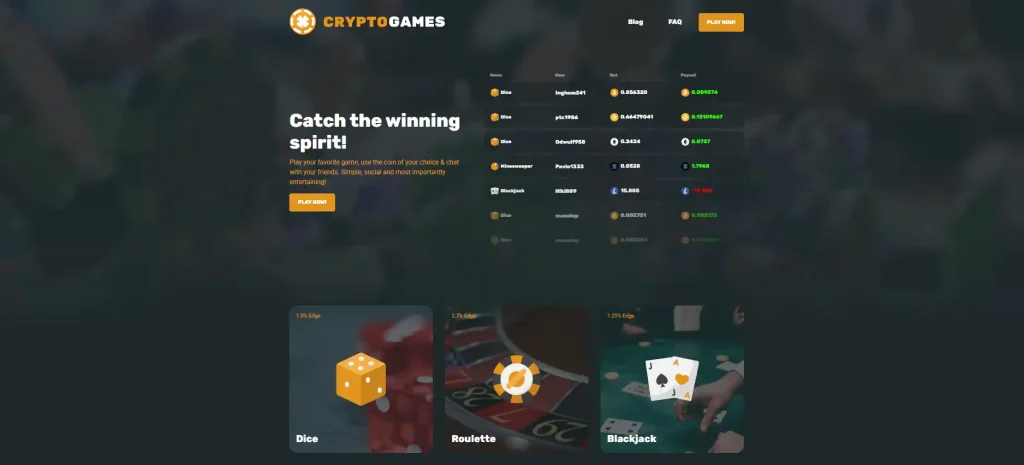
Table of Contents
- Ten games define the entire casino product
- Published house edges make comparison unusually direct
- Small edges still compound over repeated betting
- Provably fair checks the result, not the outcome for you
- A compact catalog changes what variety means
- Dice and Roulette add jackpots to a long-running core
- Questions about Crypto-Games games
- Crypto-Games is strongest when you want transparent mechanics over breadth
Section element
In-house provably fair catalog
Crypto-Games takes the opposite approach from a large aggregator casino: it offers 10 custom-built in-house games instead of thousands of third-party titles. The catalog spans dice, table-style, card, number and arcade-like mechanics, with published house-edge figures for the games and a provably fair model built around hashes and seeds.
Section element
- 10 in-house games
- 1.0% lowest published numeric edge among the listed games
Ten games define the entire casino product
The Crypto-Games catalog is deliberately small: Dice, DiceV2, Roulette, Blackjack, Keno, Minesweeper, Video Poker, Plinko, Slot and Lottery. These are all in-house titles. The casino does not rely on third-party studios, and there is no live-dealer catalog or sportsbook competing for attention.
That product shape matters more than the raw count. A typical aggregator casino uses breadth as the core selling point, while Crypto-Games puts more weight on custom mechanics, published house-edge figures and a common provably fair framework. The dedicated Crypto-Games originals guide breaks down the in-house catalog structure in more detail.
Dice and probability games
Dice, DiceV2, Keno and Lottery form the number-driven side of the catalog. The published numeric house edges are especially low for Dice, DiceV2 and Keno.
Table and card formats
Roulette, Blackjack and Video Poker provide familiar casino structures, but they remain Crypto-Games’ own implementations rather than third-party studio titles.
Arcade-like mechanics
Minesweeper, Plinko and Slot round out the catalog with faster visual mechanics while staying inside the same in-house model.
Published house edges make comparison unusually direct
Crypto-Games publishes game-level house-edge figures across the catalog. That makes the mathematical cost easier to compare than a lobby where each title comes from a different studio with its own rules and return profile. The published Lottery figures conflict, so it is best treated as very low or near-zero rather than assigned one fixed number.
| Game | Published house edge | Catalog model |
|---|---|---|
| Dice | 1.0% | In-house |
| DiceV2 | 1.0% | In-house |
| Minesweeper | 1.0% | In-house |
| Keno | 1.0% | In-house |
| Blackjack | 1.25% | In-house |
| Plinko | 1.72% | In-house |
| Slot | 1.97% | In-house |
| Video Poker | 2.09% | In-house |
| Roulette | 2.7% | In-house |
| Lottery | Very low / near-zero; sources differ | In-house |
At the low end, Dice, DiceV2, Minesweeper and Keno are each listed at 1.0%. Blackjack is published at 1.25%, followed by Plinko at 1.72%, Slot at 1.97%, Video Poker at 2.09% and Roulette at 2.7%. Those figures describe expected mathematical cost over repeated play; they do not predict the result of a short session.
Small edges still compound over repeated betting
A low house edge reduces the theoretical cost per unit wagered, but turnover matters just as much as the headline percentage. For example, a 1.0% edge applied to a reader-scenario total of $1,000 in wagers corresponds to a theoretical $10 expected loss. The same 1.0% applied to $10,000 in total wagers corresponds to $100. Those are mathematical expectations, not promises about a specific session.
| Scenario turnover | 1.0% theoretical cost | 2.7% theoretical cost |
|---|---|---|
| $100 | $1.00 | $2.70 |
| $1,000 | $10.00 | $27.00 |
| $10,000 | $100.00 | $270.00 |
- House edge describes the casino’s long-run mathematical advantage, not a session result.
- Total wagering volume determines how much exposure is applied to that edge.
- Lower edge reduces expected cost but does not remove volatility or the chance of losing quickly.
- Comparing edge figures is most useful when the game rules and bet sizes are also understood.
The site’s provably fair guide explains the separate verification layer behind game-result integrity. Mathematical edge and cryptographic fairness answer different questions.
Bet size also changes how quickly theoretical exposure accumulates. Repeating a small wager many times can create the same total turnover as making fewer large wagers, even though the session feels very different. That is why the useful comparison is not only the edge printed beside a game, but edge multiplied by total amount wagered. Variance can still dominate a short session, so a lower mathematical edge should be read as lower long-run cost per unit wagered rather than as protection from a losing streak.
Provably fair checks the result, not the outcome for you
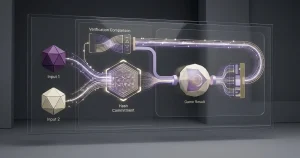
All 10 Crypto-Games titles are provably fair, with verification based on hashes and seeds. That system is designed to let a player inspect whether a result follows from the committed cryptographic inputs. It does not change the house edge and it does not make short-term results predictable.
What provably fair can check
- Whether the result can be recomputed from the relevant seed inputs.
- Whether the disclosed result is consistent with the cryptographic commitment.
- Whether the game outcome can be inspected independently of a visual animation.
What it cannot guarantee
- A profit or a favorable short session.
- Low variance simply because the edge is small.
- That account, bonus or payment issues will never occur outside the game calculation itself.
A compact catalog changes what variety means
With no external provider lobby and no live-dealer product, variety comes from switching mechanics rather than switching studios. A player can move from Dice to Blackjack or Plinko, but not from one supplier’s interpretation of a game to another supplier’s version. This makes the catalog easier to map but much narrower than a multi-provider casino.
The benefit is consistency. The titles share an in-house identity and the same broad fairness philosophy. The cost is obvious: if your idea of casino variety depends on hundreds or thousands of slots, multiple live studios or frequent provider releases, Crypto-Games does not offer that model.
- Game count
- 10 in-house titles
- Third-party providers
- None in the catalog
- Live dealer
- Not offered
- Sportsbook
- Not offered
- Fairness model
- Provably fair across the game set
Dice and Roulette add jackpots to a long-running core
Progressive jackpots are available on Dice and Roulette. They add another layer to games that otherwise emphasize transparent mechanics and published edge figures. Jackpot participation does not change the need to understand the base game and its risk; a larger possible prize does not make the underlying wagering cost disappear.
Dice is also the clearest longevity signal in the catalog. Industry coverage reported that the game passed roughly 9.2 billion bets, a milestone that fits the brand’s history as a crypto-native casino operating since 2014. The scale is useful context for how central Dice has been to the product, not evidence that any individual player has an advantage.
For the overall operator context beyond games, return to the full Crypto-Games review.
Questions about Crypto-Games games
How many games does Crypto-Games have?
Crypto-Games has 10 in-house games: Dice, DiceV2, Roulette, Blackjack, Keno, Minesweeper, Video Poker, Plinko, Slot and Lottery.
Does Crypto-Games use third-party casino providers?
No. Crypto-Games uses an in-house catalog without third-party game studios, live-dealer tables or a sportsbook.
Which Crypto-Games games have the lowest published house edge?
Dice, DiceV2, Minesweeper and Keno are each published at a 1.0% house edge. Blackjack is listed at 1.25%, with higher figures for Plinko, Slot, Video Poker and Roulette.
What is the Crypto-Games Lottery house edge?
The published sources conflict on the exact Lottery figure, so it is safer to describe the game as having a very low or near-zero house edge rather than fixing one percentage.
Are Crypto-Games games provably fair?
Yes. The games are provably fair, with verification based on hashes and seeds. Provably fair checks result integrity; it does not remove the house edge or gambling variance.
Does Crypto-Games have progressive jackpots?
Progressive jackpots are available on Dice and Roulette.
Crypto-Games is strongest when you want transparent mechanics over breadth
The game library is compact: 10 in-house titles, published edge figures, provably fair verification and no third-party or live-dealer layer. That makes the product easy to inspect and mathematically compare, but it also makes the trade-off clear. Crypto-Games suits readers who value a small, transparent custom catalog more than the breadth of a conventional multi-provider casino lobby.
Crypto-Games Games 2026 — More on this topic at Crypto-Games Review.
See also Crypto-Games Bonus 2026.